Paul Welty, PhD WORK, BEING, AND STAYING HUMAN

Found: found

308 posts tagged with "found"

Balancing Values and Revenue: Lessons from Parting Ways with a Major Client

“No one likes to lose a client, particularly when that client is your biggest one and you’ve had a great relationship with them for years.”

Sins of an Agency: Parting Ways With Our Biggest Client

Understanding Customer Concentration Risks

High customer concentration at Vixen Digital posed significant risks, with one client providing a large portion of the agency’s revenue. Initially beneficial, this relationship turned problematic, demonstrating the perils of over-reliance on a single client.

 read more >

Disrupting the Bitterness Loop: Understanding and Overcoming the Cycle of Entitlement and Resentment

“When we’re busy looking for more reasons to be bitter, we’re not taking the time to do generative work, to connect and to find opportunities to make things better.”

The bitterness loop

Understanding the Bitterness Loop

Seth’s Blog article “The bitterness loop” explores the debilitating effects of bitterness and entitlement. The core argument posits that bitterness arises from a sense of entitlement and persistently seeks validation, thereby stifling constructive efforts and connections. This cycle of bitterness not only sustains itself but intensifies unless …

 read more >

Flipped Classrooms: Small Gains with Significant Effort – An Analytical Review

“My takeaway message is that it could be better, but only when it is appropriately designed.” - David C.D. van Alten .

PROOF POINTS: 114 studies on flipped classrooms show small payoff for big effort

Understanding the Impact of Flipped Classrooms

Flipped classrooms, where students engage with lecture content at home and participate in activities during class, promise a transformative educational approach. Yet, a recent meta-analysis of 114 studies reveals only modest learning gains. This analysis underscores the need for careful and strategic implementation to realize the full …

 read more >

Overcoming "Work About Work": Strategies for Enhancing Productivity and Efficiency

“According to Asana’s Anatomy of Work Index, 60% of a person’s time at work is spent on work about work and not on skilled work”>
How work about work gets in the way of real work

Understanding “Work About Work”

In our dynamic business landscape, “work about work” has emerged as a critical issue. As defined by Asana, this term refers to non-productive activities such as managing emails, chasing status updates, and switching between apps. According to Asana’s Anatomy of Work Index, these tasks consume 60% of a knowledge worker’s time. This …

 read more >

The Future of Hiring: Why AI Skills Are Outpacing Industry Experience

“AI is democratizing expertise across the workforce. Our latest research highlights the opportunity for every organization to apply this technology to drive better decision-making, collaboration — and ultimately business outcomes.">
71% of leaders prefer hiring candidates with AI skills over those with the relevant industry experience

AI Skills Dominate the Job Market: A New Paradigm

The 2024 Annual Work Trend Index by Microsoft and LinkedIn reveals a significant shift in employer preferences. A striking 71% of executives now prioritize candidates with artificial intelligence …

 read more >

Jasper is a useful tool for developing employee training.

The article discusses various aspects of employee training and development, providing insights and recommendations on how to incorporate industry trends, cater to different learning styles, evaluate program success, create interactive training methods, and implement best practices. The author emphasizes the need to align training programs with specific business goals, adapt to employee demographics, and ensure engagement and participation. Additionally, they suggest utilizing metrics, data analysis, and innovative approaches such as gamification and simulations to enhance effectiveness. … read more >

The IMF Warns About AI's Impact on Inequality

The International Monetary Fund (IMF) has warned that artificial intelligence (AI) could worsen inequality among nations if not properly addressed by policymakers. The IMF states that AI is likely to affect around 60% of jobs in advanced economies, with some workers benefiting from the integration of AI while others risk losing their jobs. The IMF urges countries to establish social safety nets and provide retraining programs to protect vulnerable workers and curb inequality. The IMF’s analysis coincides with discussions on AI at the World Economic Forum in Davos. China has already … read more >

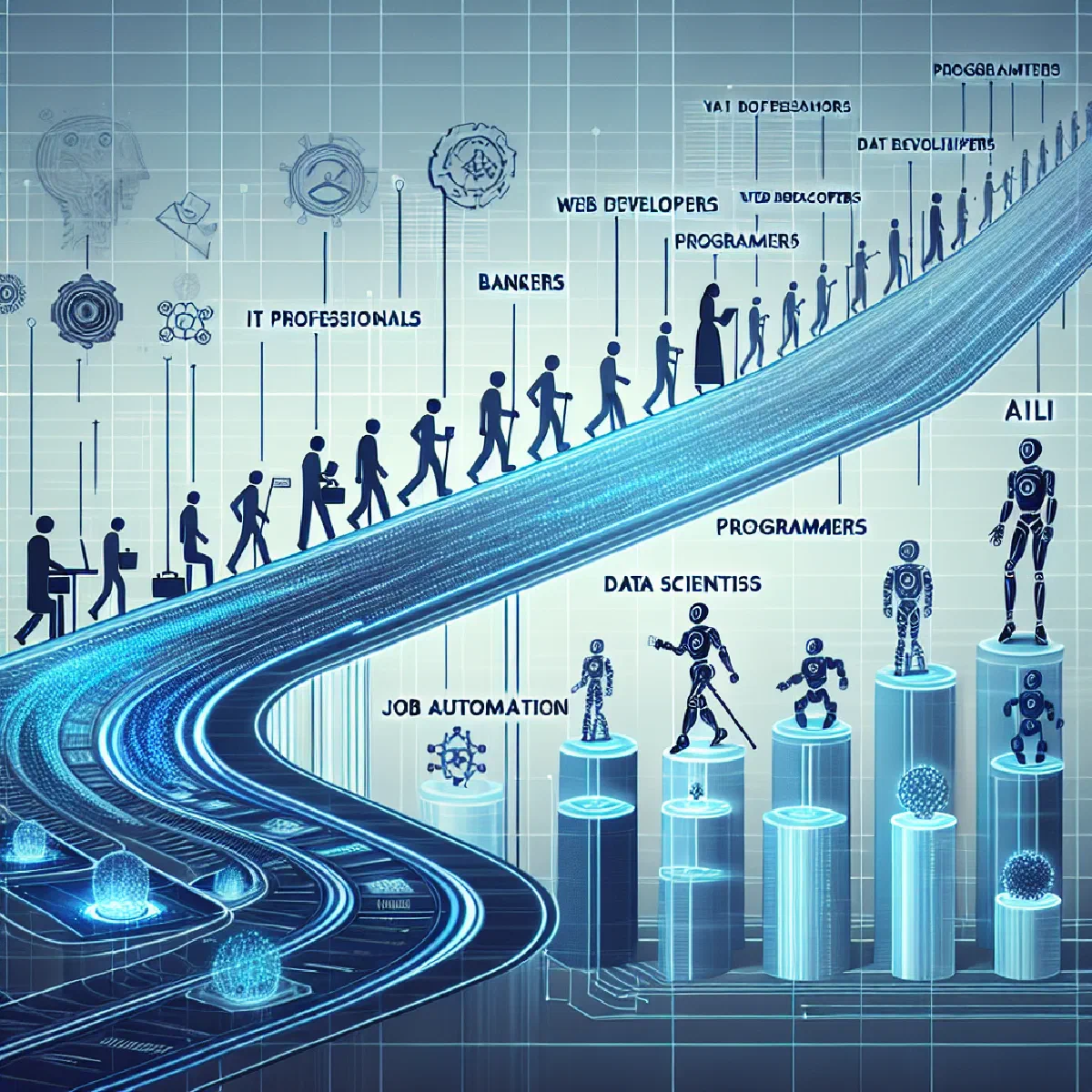
It's going to take a century for artifical intelligence to be able to perform most human jobs. But there are going to be some key developments during the next decade.

According to a survey of leading AI researchers, all human tasks may become highly automatable by 2116. While this prediction seems far off, it is worth noting that it has been moved up by 50 years from the original estimate of 2164. Short-term developments are also expected to reshape IT and business professionals’ jobs within the next five to 10 years. The survey highlights several capabilities that AI will achieve in the near future, including finding and patching security flaws, building websites, offering phone banking services, writing Python code, finetuning large language models, … read more >

Many businesses are not yet prepared to fully reap the benefits of AI.

AI has become a ubiquitous technology, with companies exploring its applications for revenue growth and improved customer and employee experiences. However, most businesses are unprepared to leverage AI to its fullest extent, limiting its potential. Only a small number of companies are successfully applying AI to improve their operations and create new value. AI-powered automation, when combined with specialized and generative AI, can boost productivity, eliminate errors, and achieve faster results. Successful examples include Cathay Pacific, British Airways, and Intel. To fully deliver on its … read more >

Rose-tinted predictions for artificial intelligence’s grand achievements will be swept aside by underwhelming performance and dangerous results.

The year 2023 saw widespread hype around generative AI, with expectations of AI-powered advancements becoming common. However, in 2024, there will be a need to readjust expectations as evidence emerges showcasing the limitations of generative AI. These models are prone to providing false information and hallucinations, making it difficult to anchor predictions to known truths. Anticipation of exponential productivity improvements and artificial general intelligence will prove unfounded, leading to a shift in focus towards identifying human tasks that can be augmented by these models. Moreover, … read more >